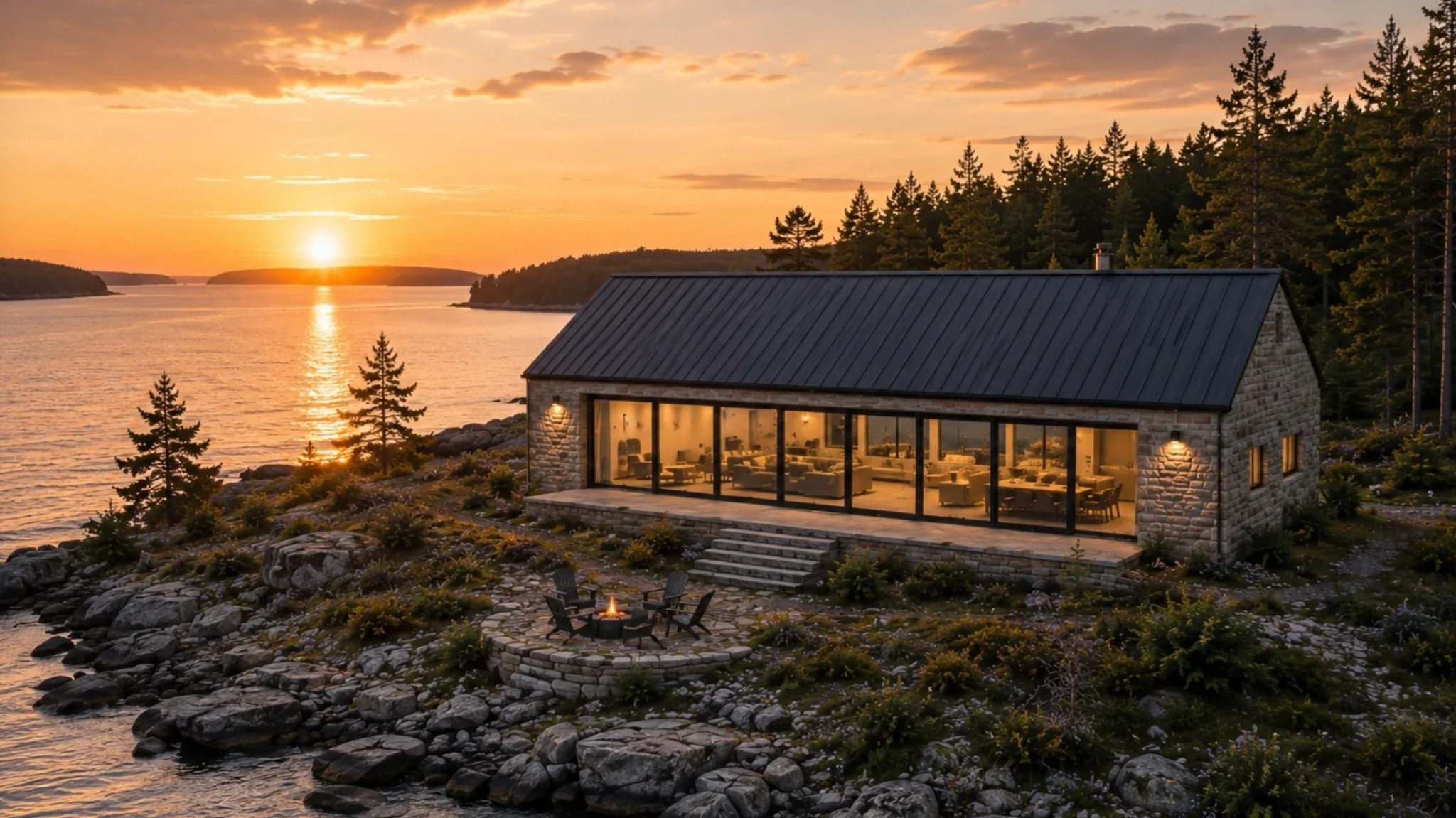
Exploring a modern coastal home designed around privacy, permanence, and the experience of the water.
There is something about the Maine coast that asks architecture to show restraint.
For a waterfront site at Indian Head Shores in Jonesport, Maine, I began exploring what a residence could become if the architecture responded directly to the character of the land: rugged shoreline, evergreen woodland, native stone, and expansive views toward the water and islands beyond.
The concept is intentionally simple. A compact, one-story gabled form creates a home that feels quiet and grounded within the landscape rather than competing with it.
But the experience changes depending on which side of the house you encounter.
From the land, the residence is restrained and private. Natural cut stone, a centered entry, small horizontal windows, and a dark standing-seam metal roof create an arrival that feels solid and protected. Toward the water, that sense of enclosure gives way to glass.
The waterfront elevation opens almost entirely to the view, allowing the landscape to become part of the interior experience. Rather than creating a larger house simply for the sake of scale, the concept uses transparency and the horizon beyond it to make a relatively compact footprint feel expansive.
It is an approach centered on experience: quiet from the road, dramatic at the water. This land-to-water contrast is one of the central ideas in my original concept.
Modern Architecture That Belongs on the Maine Coast
Designing a modern waterfront residence in Maine does not have to mean introducing something foreign to the landscape.
Here, I’ve kept the material palette deliberately elemental: natural stone, dark metal, glass, and warm wood accents. The form is equally straightforward, drawing from the familiar geometry of a gabled structure while interpreting it with a more contemporary sensibility. Those materials and the low, restrained character are central to the original concept.
The approach through the woods, the moment of arrival, the transition through the house, and finally the reveal of the water are all part of the architecture. I’m interested in the experience of moving through a place just as much as the building itself.
This is currently a concept, but one I would like to see realized. Whether on this particular site or another coastal property, the idea would continue to evolve in response to the land, the views, and the person who will ultimately call it home.
If you have a waterfront property and are interested in exploring what it could become, I’d welcome the conversation.